
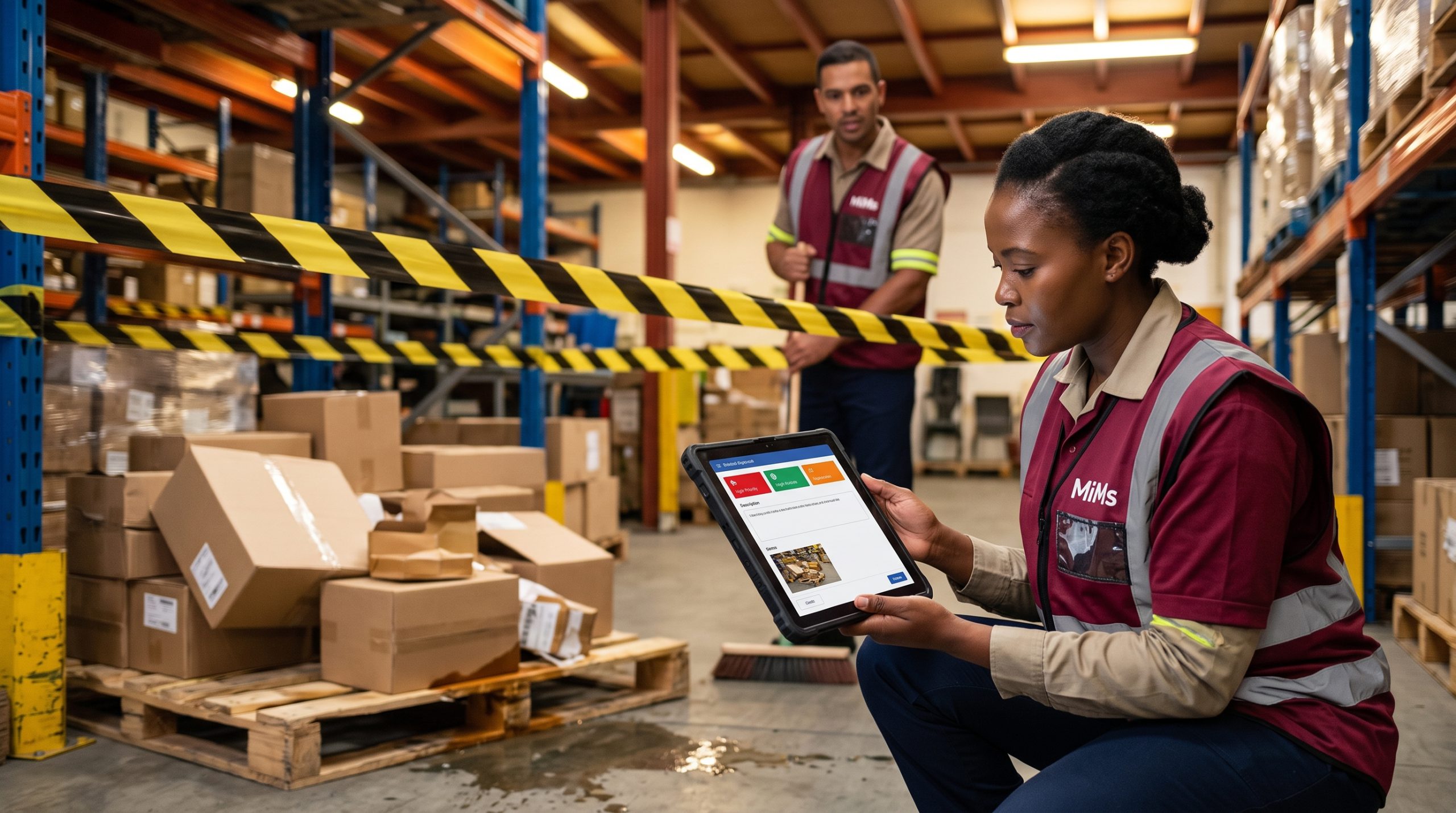
INCIDENT MANAGEMENT
Every incident captured, escalated and closed — with a record that stands up.
Log any of 23 incident types from the floor, attach witness statements and injury body-maps, and let SLA deadlines drive it to close-out. Every action is timestamped, so the record holds up in a hearing, an audit or a court.
POPIA-aligned · Hosted in South Africa · Offline capture · SLA deadlines · Full audit trail
THE PROBLEM
Incidents get logged late, lost in email, and closed without proof.
Reported days later
Paper forms and WhatsApp threads mean the incident surfaces long after the scene has changed and memories have faded.
No ownership, no deadline
Without an SLA clock and a named owner, actions drift. Nobody knows what is overdue until an inspector asks.
Records that don’t hold up
Missing statements, no timestamps and edited notes leave you exposed at a disciplinary hearing or a CCMA referral.
HOW IT WORKS
From first report to signed-off close-out.
Capture on site. A supervisor logs the incident on mobile — online or offline — choosing from 23 incident types with the right fields for each.
Record the detail. Add witness statements, photos and an injury body-map. The evidence is attached to the incident, not scattered across inboxes.
Escalate on the clock. SLA deadlines start automatically and route the incident to the right manager, escalating tier by tier if it stalls.
Raise the corrective work. The incident auto-raises a non-conformance so root cause and corrective action are tracked to completion, not forgotten.
Close with proof. Actions are verified and signed off, leaving a complete, timestamped record ready for audit or hearing.
CAPABILITIES
Built for the incidents your operation actually runs.
23 incident types
Injuries, near-misses, security events, environmental spills, property damage and more — each with fields that fit the event.
SLA deadlines
Every incident carries a clock. Overdue items escalate automatically so nothing sits unactioned.
Witness statements
Capture statements at the scene, attributed and timestamped, so the account is preserved before it is lost.
Injury body-mapping
Mark the site and nature of injury on a body diagram for accurate reporting and trend analysis.
Auto-raised non-conformances
Serious incidents automatically open a CAPA record so corrective action is tracked to close-out.
Offline capture
Log incidents underground, in a warehouse or on the road; records sync the moment a connection returns.
ON THE DATA SPINE
One incident, connected to everything it should trigger.
Incident Management does not sit in a silo. A logged injury feeds your safety statistics, raises a non-conformance for corrective action, and — where wrongdoing is suspected — hands off to a formal investigation. Because it all runs on one data spine, a single capture updates every downstream record without re-keying.
What feeds it
- Audits & inspections surface unsafe conditions that become incidents
- Stock counts flag losses that escalate to security incidents
What it feeds
- Non-conformance & CAPA for corrective action and close-out
- Investigation & case management when wrongdoing is suspected
WHERE IT’S USED
Proven across high-risk, multi-site operations.
Mining
MHSA-ready injury and near-miss capture underground and on surface, with body-mapping and SLA-driven close-out.
ExploreRetail
Security events, shrinkage and customer incidents logged per store and escalated to the right manager.
ExploreLogistics
Vehicle, cargo and depot incidents captured on the road and reconciled against SLA deadlines.
Explore“We went from finding out about incidents a week later to seeing them the same shift. The SLA clock changed how our managers behave — nothing sits open anymore.”
Named references are available under NDA.
FAQ
Incident management questions.
Can our teams log incidents without signal?
Yes. Incidents are captured on mobile whether the device is online or offline. Records queue locally and sync automatically once a connection returns, so underground or on-road events are never lost.
How do SLA deadlines work?
Each incident type carries its own deadline. When an incident is logged, the clock starts and routes it to the responsible owner. If it stalls, it escalates tier by tier so overdue work is visible to management before it becomes a problem.
Will the record hold up at a disciplinary hearing?
Every action, statement and attachment is timestamped and retained in a full audit trail. Nothing is silently edited, so the record stands up in a hearing, a CCMA referral or an external audit.
What happens when an incident needs corrective action?
Serious incidents automatically raise a non-conformance in the CAPA register, with an owner, deadline and risk rating, so root cause and corrective action are tracked all the way to verified close-out.
Is our data kept in South Africa?
Yes. The platform is hosted in South Africa and POPIA-aligned, with role-based access so incident detail is only visible to those who need it.
RELATED MODULES
Works hand in hand with.
See incidents close themselves out.
Book a demo and watch a live incident move from capture to verified close-out on the data spine.