
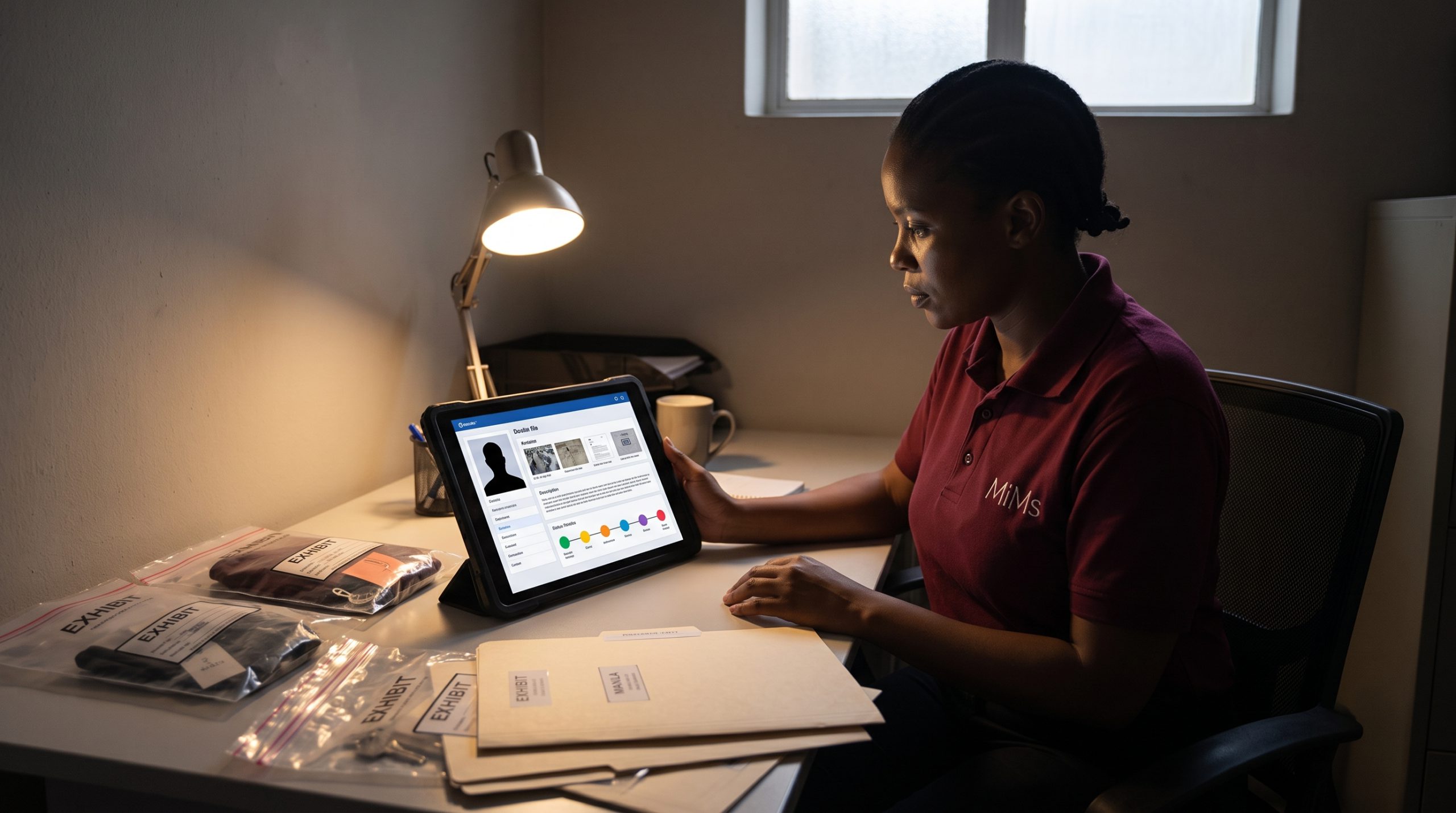
INVESTIGATION & CASE MANAGEMENT
From suspicion to disciplinary-ready docket.
Run every investigation as a formal case: suspects, an evidence register, statements and an investigator’s diary, all behind restricted access and a full audit log. When you reach a decision, the docket is complete, defensible and ready for a hearing.
POPIA-aligned · Hosted in South Africa · Restricted access · Chain-of-custody · Full audit log
THE PROBLEM
Investigations fall apart on process, not on facts.
Evidence scattered
Statements in one folder, CCTV on a memory stick, notes in a diary. When it matters, half of it can’t be found.
No access control
Sensitive cases sit in shared drives anyone can open, tainting the process and breaching POPIA.
Cases collapse at hearing
A broken chain of custody or an undocumented decision hands the case to the other side.
HOW IT WORKS
One case, from opening to signed-off outcome.
Open the docket. Raise a case from an incident, a stock variance or a tip-off, and set access so only the assigned team can see it.
Name the parties. Add suspects and persons of interest, linking prior incidents and cases already on the data spine.
Register the evidence. Log every exhibit, statement and file with a timestamp, preserving chain of custody in one evidence register.
Keep the diary. The investigator records each step in a running diary, so the full history of the case is never in doubt.
Close disciplinary-ready. Reach an outcome with the complete docket assembled, exportable and defensible at a hearing.
CAPABILITIES
Everything a defensible case needs, in one place.
Case dockets
Each investigation is a structured docket that gathers parties, evidence, statements and decisions in one record.
Suspect register
Track suspects and persons of interest, with links to related incidents and prior cases.
Evidence register
Log exhibits and files with timestamps to preserve chain of custody from seizure to hearing.
Statements
Capture and attribute witness and suspect statements directly against the case.
Investigator diary
A running, timestamped log of every action taken, so the conduct of the investigation is itself on record.
Restricted access & audit log
Role-based access keeps sensitive cases confidential; a full audit log records who saw and did what.
ON THE DATA SPINE
Cases that inherit their evidence, not chase it.
Because investigations sit on the same data spine as incidents and stock counts, a case opens with its context already attached. An injury that turns out to be assault, or a stock variance that points to theft, escalates into a docket without re-capturing a thing — and the outcome can raise corrective action to stop it recurring.
What feeds it
- Incident management escalates events involving wrongdoing
- Stock counts & shrinkage hand high-variance branches to investigation
What it feeds
- Non-conformance & CAPA for corrective action after a finding
- Document library for controlled disciplinary records and policy
WHERE IT’S USED
Where the stakes make process non-negotiable.
Mining
Investigate safety breaches, theft and misconduct with restricted dockets that survive scrutiny.
ExploreRetail
Turn shrinkage and till-fraud suspicions into disciplinary-ready cases, store by store.
ExploreLogistics
Cargo loss and driver misconduct investigated with a clean chain of custody across depots.
Explore“Before MiMs, half our cases fell over on a technicality. Now the docket is complete before we even sit down — evidence, statements, diary, all timestamped. Our win rate at hearings changed overnight.”
Named references are available under NDA.
FAQ
Investigation questions.
Who can see a sensitive case?
Access is restricted to the assigned investigation team by role. Cases do not appear in general views, and every access event is written to the audit log so you always know who has viewed a docket.
How do you preserve chain of custody?
Every exhibit and file is logged in the evidence register with a timestamp and handler. Nothing is silently altered, so the provenance of each item is clear from seizure through to a hearing.
Can we open a case straight from an incident?
Yes. An incident or a high-variance stock count can escalate directly into a case, carrying its evidence and context onto the data spine so nothing is re-captured.
Is the platform POPIA-aligned for personal data in cases?
Yes. The platform is hosted in South Africa and POPIA-aligned, with role-based access and a full audit trail governing who can see personal information held in a case.
Can we export a docket for a hearing?
Yes. The complete docket — parties, evidence register, statements, diary and outcome — can be assembled and exported as a defensible record for a disciplinary hearing.
RELATED MODULES
Works hand in hand with.
Build cases that stand up.
Book a demo and see a suspicion move to a disciplinary-ready docket, start to finish.