
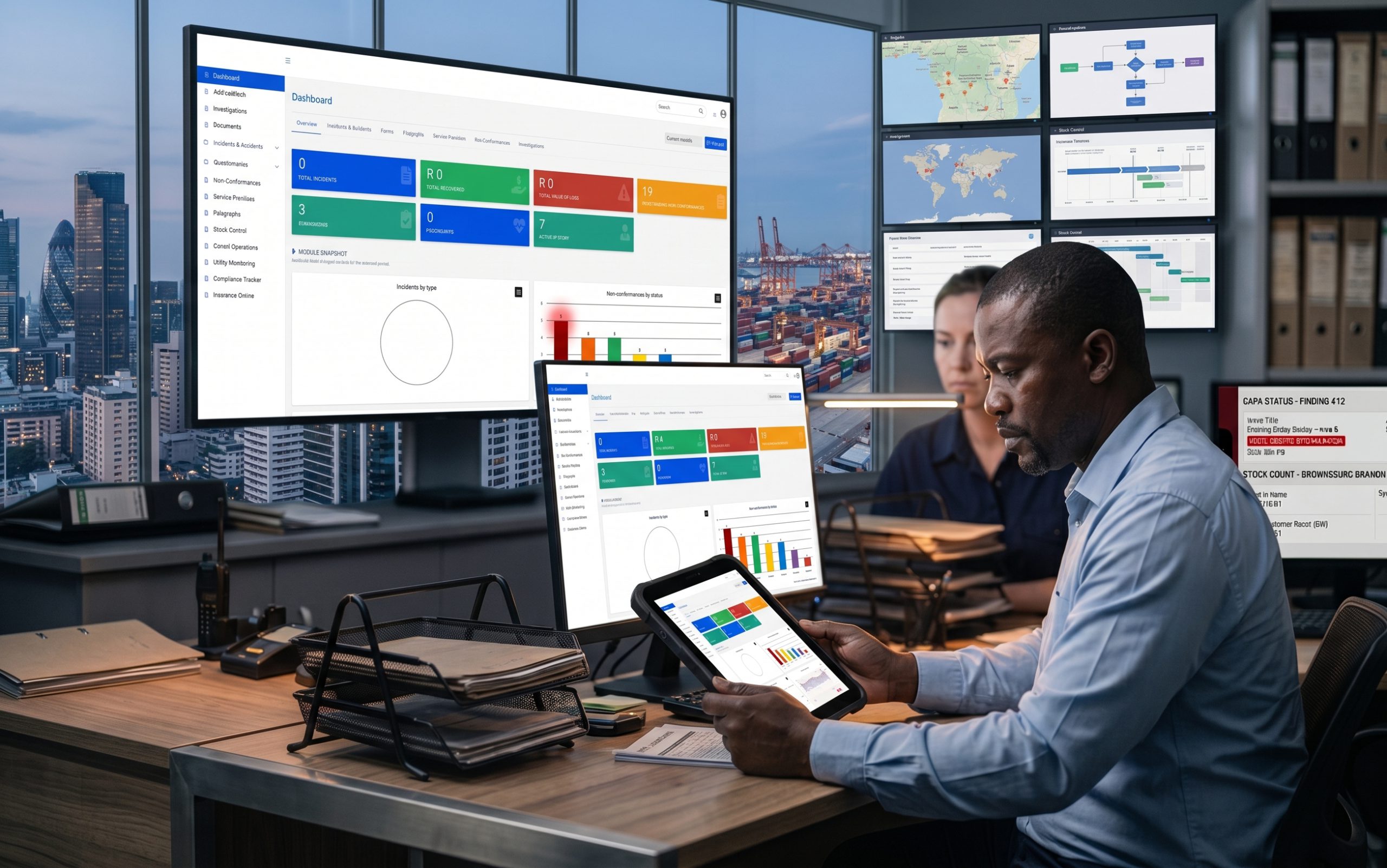
The platform
One platform. Ten modules. A single data spine.
MiMs is not a bundle of point tools. Every module shares one hierarchy, one audit trail and one escalation engine — so a failed checklist, a stock variance and an investigation are the same story, told once.
The architecture
Built on a shared spine, in buyer language.
Three things every module inherits — the reason MiMs behaves like one system, not five.
One hierarchy
Company → Region → Branch → Area. Configure it once; every module, report and permission respects it.
One audit trail
Who did what, when, from where — captured on every record, immutable, and ready for the auditor or the hearing.
One escalation engine
SLAs, owners and tier-by-tier escalation work identically whether it’s a near-miss, a finding or a document review.
The data spine
Every module feeds the next.
The connective tissue no point solution can copy. Watch one event travel the loop.
Capture. A store checklist fails an item on the morning inspection.
Raise. MiMs opens a non-conformance automatically — owner, deadline, risk rating.
Escalate. No action by the deadline? It escalates, tier by tier, until someone owns it.
Investigate. The pattern repeats across branches? Open an investigation with the evidence already attached.
Review. It all lands on the next review meeting’s agenda — generated for you — and closes on the record.
Point solutions solve a department. MiMs runs the operation.
The modules
Enable what you need. They already work together.
Incidents & Accidents
23 incident types, SLA deadlines, statements and injury mapping — captured and closed.
→Investigations & Case Management
Dockets with suspects, evidence, statements and a full diary — disciplinary-ready.
→Audits, Inspections & Checklists
Five form types on one scored engine, with RAG dashboards and automatic CAPA.
→Non-Conformances & CAPA
Findings that escalate until they close — the register every module feeds.
→Stock Counts & Shrinkage
Variance the day it happens — linked straight to an investigation.
→Document Library
Controlled documents with approval, versions and proof of distribution.
→Covert Operations & Polygraph
Compartmentalised, need-to-know case files, tied to investigations.
→Service-Provider Compliance
Every contractor compliant — documents, inductions and expiry — before site entry.
→Meetings & Reviews
Agendas that write themselves from open findings; minutes captured back to the register.
→MiMs Intelligence (AI)
Deterministic, auditable AI that summarises, drafts and surfaces risk patterns.
→Integrations & API
REST API, SSO, webhooks and IoT — connect HR, POS, access control and BI.
→Mobile & Offline
Capture underground, on the road and through load-shedding; sync when back online.
→Insurance Claims Management
Log, authorise, generate the GOP and submit to the insurer — every claim on one auditable workflow.
→Configured, not assembled
A template platform makes you the systems integrator.
Generic “build-it-yourself” tools hand you a blank canvas and a services bill. MiMs ships the operational logic — SA incident types, s37(2) agreements, MHSA-ready records — already modelled.
- Purpose-built for safety, security, compliance and loss prevention — not a spreadsheet with a UI.
- South African regulatory reality modelled in, not bolted on.
- Enable modules as you grow — the spine surfaces the next one for you.
Deployment timeline
Weeks 1–2. Hierarchy, users, SSO and your first module configured.
Weeks 3–4. Forms, incident types and escalation rules tuned to your sites.
Weeks 5–6. Pilot sites live, dashboards signed off, roll-out to the estate.
Questions
Platform FAQ
Do we have to buy all ten modules?
No. Start with one — most customers begin with audits or incidents — and enable more as you grow. Because everything shares the data spine, each new module immediately connects to what you already run.
Where is our data hosted?
In South Africa, aligned to POPIA. Data residency, encryption, role-based access and a full audit trail are covered in the Security & Trust Centre.
Does it work offline?
Yes. Field capture works underground, on the road and through load-shedding, then syncs when a connection returns. See Mobile & Offline.
Can MiMs connect to our other systems?
Yes — through a documented REST API, SSO, webhooks and IoT inputs. See Integrations & API.
How long until we are live?
Typically four to six weeks for a first module and pilot sites, then a staged roll-out across the estate.
See the whole platform on your sites.
45 minutes, shaped around your operation and your risks. No slides.