
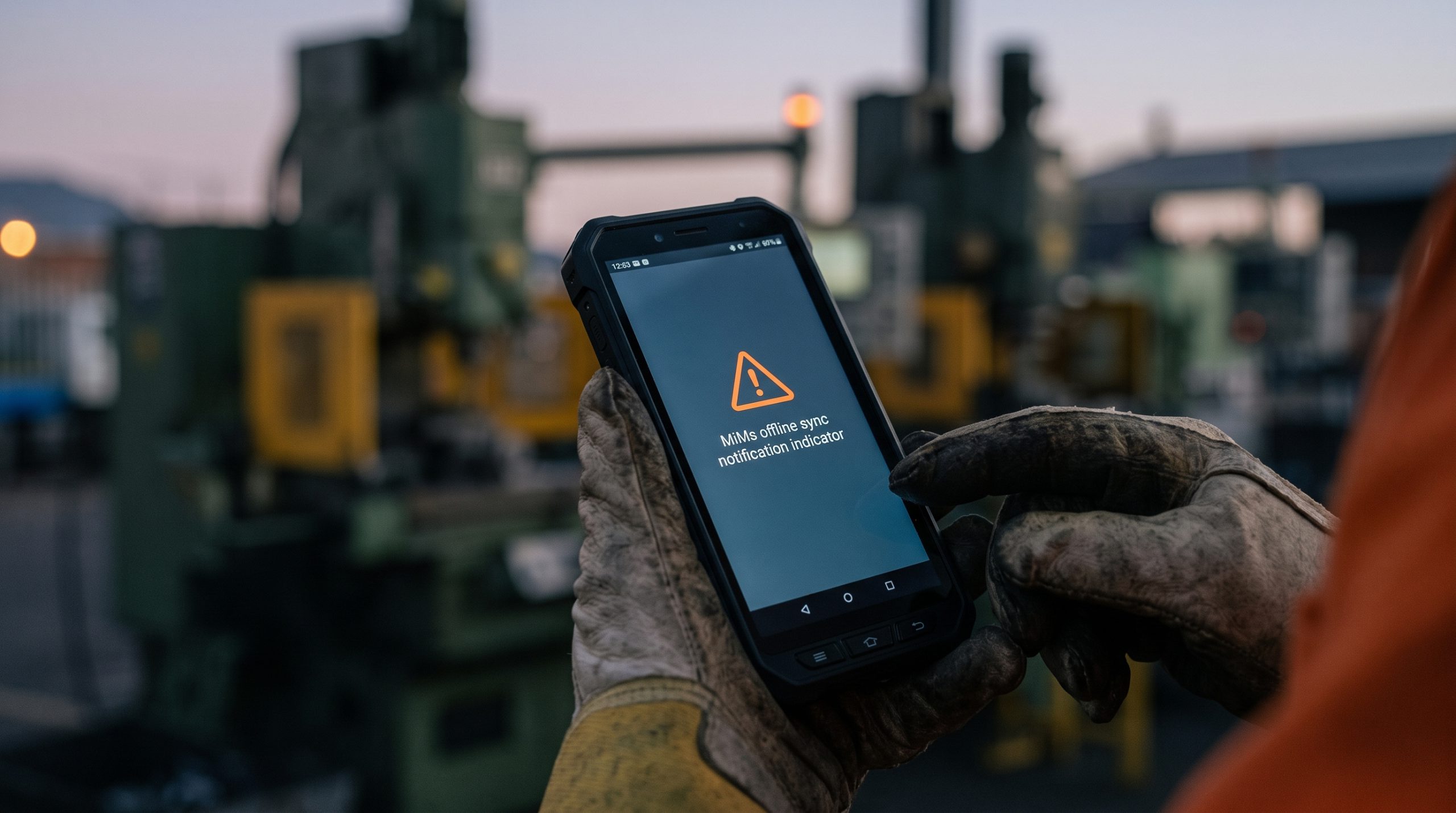
Software designed in a world of reliable, always-on connectivity tends to break the moment it meets the South African reality of load-shedding, patchy rural coverage and remote sites. For any operation that captures data in the field, offline-first is not a nice-to-have. It is a basic requirement of working here.
The connectivity assumption most software makes
Cloud applications usually assume a live connection at the moment of use. Tap save, and the record travels to a server there and then. This works fine in an office on fibre. It fails wherever the work actually happens: underground, on a highway, at a depot during stage-six load-shedding, on a farm at the edge of coverage, or in a warehouse whose thick walls block signal.
When connection-dependent software meets these conditions, the failure modes are all bad. The app spins and times out. The user gives up and writes on paper “to enter later”. Half-saved records are lost. Worst of all, capture is delayed until the person is back in coverage, by which time detail has faded and accuracy has degraded.
What “offline-first” actually means
Offline-first is an architectural stance, not a fallback feature. It means the device is treated as the primary place where data lives at the moment of capture, and the server as something it synchronises with when a connection is available, rather than the other way round.
In practice, a genuinely offline-first tool behaves like this:
- The full workflow — forms, checklists, photos, sign-offs — runs entirely on the device with no signal.
- Records are stored locally and durably the instant they are captured, not held in volatile memory.
- When connectivity returns, the device syncs automatically in the background, with no manual export step.
- Conflicts and duplicates are handled predictably, so two people working offline do not corrupt each other’s data.
The test is simple: put the device in aeroplane mode, complete a full day’s work, and confirm nothing is lost when it reconnects. That is the standard mobile offline capture has to meet.
Why load-shedding raises the stakes
Load-shedding does not only darken offices. It knocks out the cellular towers your field devices depend on, so connectivity can disappear across a whole area for the duration of a stage, not just in the usual dead spots. An operation that quietly relies on “there’s usually signal” discovers during a bad week that “usually” is not good enough.
The same event stresses your central systems too. Offices run on generators and UPS, staff work from home on unreliable links, and the infrastructure that receives and processes field data has to tolerate its own power interruptions. Resilience has to be designed end to end, not assumed.
The operational payoff
Getting this right changes behaviour on the ground. When capture works regardless of signal, people record hazards, inspections and incidents at the moment they occur, because there is no friction and no reason to defer. Data quality rises because detail is captured while it is fresh. Nothing waits in a notebook for a re-entry step that may never happen.
For dispersed operators in mining and logistics, where the most important events happen furthest from connectivity, this is often the single biggest lift in data quality available. It is also what makes downstream analysis trustworthy: a corrective-action trend or a review meeting is only as good as the field data feeding it, and field data is only reliable if it was captured accurately at the source.
Questions worth asking any vendor
If you are evaluating field-capture software for South African conditions, press on the specifics:
- Does the complete workflow function with no connection, or only a cut-down version?
- Are photos and attachments captured offline and synced later?
- What happens to a half-completed record if the device loses power mid-capture?
- How are conflicts resolved when several people work offline at once?
Vague answers here are a warning sign. Offline-first is either designed in from the start or bolted on unconvincingly later.
Key takeaway
In South African conditions, connectivity cannot be assumed at the point of capture. Offline-first treats the device as the primary place data lives, running the full workflow with no signal and syncing automatically when connection returns. Because load-shedding takes down towers as well as offices, resilience must be designed end to end — and doing so is often the single biggest improvement available in field data quality.
If your teams still capture critical records on paper because “the app doesn’t work out there”, that is a solvable problem worth looking at closely. The platform overview shows how offline capture feeds the rest of the operation once the field data is finally reliable.