
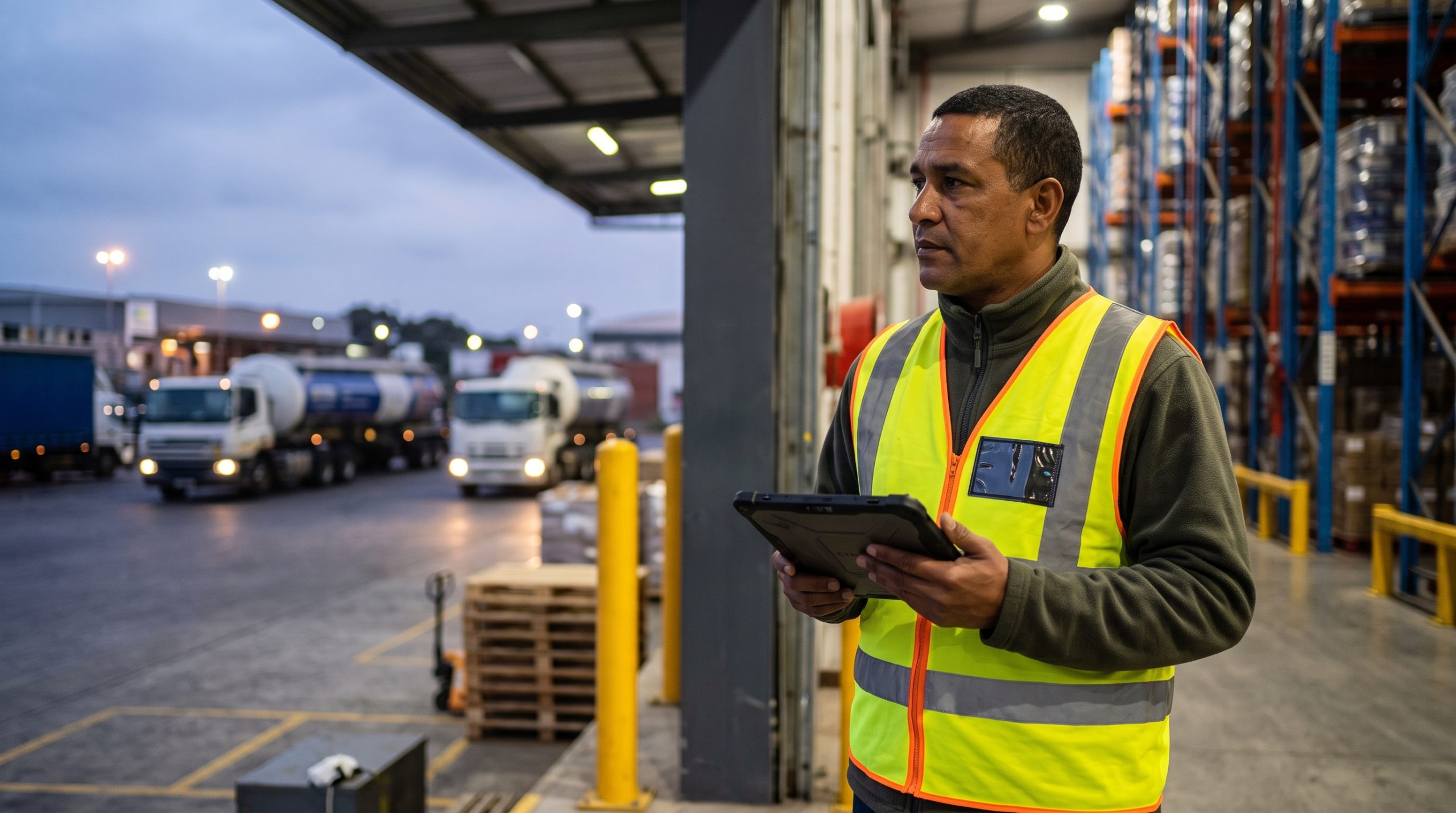
Few sectors stretch a safety, health, environment and quality (SHEQ) programme quite like transport and logistics. Your risk does not sit inside a single fenced site; it moves at highway speed across provinces, sleeps at driver rest stops, and reappears at depots you may only visit once a month.
The problem: risk that never stands still
A manufacturing plant can be walked, inspected and largely understood in an afternoon. A fleet cannot. On any given day your exposure is spread across vehicles in motion, drivers operating alone, sub-contracted hauliers, third-party depots, and loading yards where your people and someone else’s equipment share the same few metres of tarmac.
The consequence is that most incidents in logistics are discovered late and understood poorly. A near-miss at a depot in Gqeberha is scribbled in a notebook, mentioned in a WhatsApp group, and never reaches the head-office SHEQ team until it becomes a real injury three weeks later. By then the trail is cold and the pattern is invisible.
Four risk zones to manage deliberately
It helps to stop treating “fleet safety” as one thing and instead manage four distinct zones, each with its own controls.
- The vehicle. Pre-trip inspections, defect reporting, load securing and maintenance status. The goal is a defect logged by the driver at 05:00 that automatically raises a job, not a checklist that gets ticked without being read.
- The driver. Fatigue, hours of work, licensing and competency, and behaviour on the road. Fatigue in long-haul is a genuine safety hazard, not an HR footnote.
- The depot and yard. Reversing vehicles, forklift and pedestrian separation, loading-bay controls, and contractor management. Yards are where fixed-site and moving hazards collide.
- The load and the environment. Dangerous goods, spillage, emissions and community exposure along the route. This is where OHS Act duties meet environmental obligations.
Why paperwork alone fails a moving operation
Paper and spreadsheet systems assume the people generating records and the people reading them are in the same building. In logistics they never are. A binder of inspection sheets at a satellite depot is invisible to the executive who carries the legal duty for the whole operation.
The practical fix is to move capture to where the work happens: a driver or depot supervisor records an inspection, a near-miss or a defect on a phone, at the vehicle or in the yard, and it is instantly visible to everyone who needs to act. Because coverage and load-shedding both interrupt connectivity, that capture has to work offline and sync later rather than depending on a live connection at a fuel stop.
Turning scattered records into a fleet-wide picture
The real prize is not digitising forms; it is being able to see across the network. When every inspection, incident, defect and corrective action shares one structure, questions that were previously unanswerable become routine:
- Which depots generate the most near-misses per thousand movements?
- Are reversing incidents concentrated at yards with a particular layout?
- Do vehicle defects cluster around a maintenance provider or a route?
- Are corrective actions from the last audit actually closed, or just logged?
That last point matters most. A finding without a tracked corrective action is only a note. Connecting every finding to a documented, owned and time-bound corrective action is the difference between a SHEQ system that improves the operation and one that merely records its failures. This is also the backbone of ISO 9001 and 45001-ready quality and safety management.
Governance across sites you rarely visit
Multi-site operators face a governance gap: the executive accountable under the OHS Act cannot personally inspect forty depots. What they can do is insist on consistent controls and a single view of performance across all of them. When depot managers work to the same templates and their data lands in one place, the head-office team manages by exception, focusing attention on the sites and trends that need it rather than chasing paperwork. For operations leaders, that consolidated view is the point of a connected logistics platform.
Key takeaway
In transport and logistics your risk moves, so your SHEQ system has to move with it. Capture inspections, near-misses and defects where the work happens, make that capture work offline, and connect every finding to a tracked corrective action. Do that consistently across every depot and vehicle and you turn scattered paperwork into a fleet-wide picture you can actually manage.
If you are mapping out how to bring a dispersed fleet and depot network under one consistent SHEQ view, it is worth seeing how the pieces fit together before committing to a full roll-out. Our platform overview walks through how connected capture, corrective actions and reporting work as a single system.